

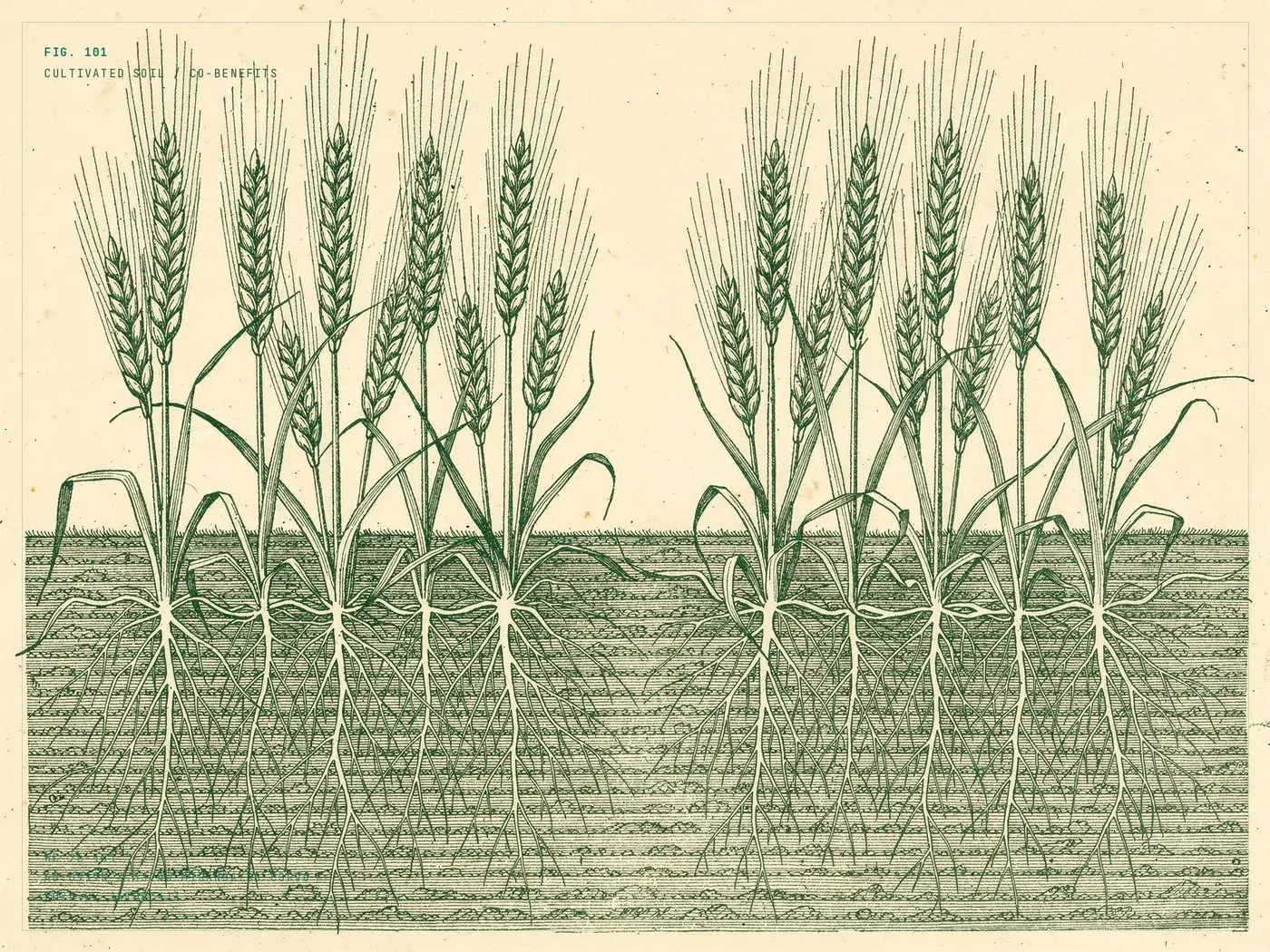
There is a version of the biochar story that promises everything: more yield, less water, less fertiliser, healthier soil, and a carbon credit on top. It is a bad story, not because the benefits are imaginary — several are well supported — but because stating them without conditions is how a good material acquires a bad reputation.
The useful framing is narrower and more defensible. Biochar is a soil conditioner, not a fertiliser. Its porous, high-surface-area structure changes how a soil holds water, retains nutrients and hosts microbial life. Those changes matter a great deal in some soils and very little in others — and knowing which is which is the whole of the practical knowledge [1][2].
What the structure actually does
The same physical property that makes biochar durable makes it agronomically interesting: pyrolysis preserves the plant's cellular architecture as a rigid honeycomb of pores, giving an enormous internal surface area per gram. That structure acts on soil in three mechanical and chemical ways.
Fig. 1 — Three mechanisms — pore structure, surface charge, habitat
Water. In coarse, sandy soils — the soils that drain too fast and dry out first — added porosity raises the water a soil can hold in the range roots can reach. This is the most consistently reported physical benefit, and it is also the most conditional: in a heavy clay that already holds water well, the same addition does much less [1][2].
Nutrients. Biochar surfaces carry charge, and charged surfaces hold onto positively-charged nutrient ions — ammonium, potassium, calcium, magnesium — instead of letting them wash below the root zone. The effect is generally described as an increase in cation exchange capacity, and its practical consequence is less leaching and better use of the fertiliser already being applied [1][3].
Life. The pore network is habitat. Pores in the size range biochar provides shelter bacteria and fungal hyphae from predation and desiccation, and the surfaces adsorb the organic compounds that feed them. A more active soil biology is the mechanism behind several of the slower, cumulative effects reported in long-term trials [1][2].
Where the evidence is strong, and where it is conditional
Meta-analyses of field trials find a positive average effect on crop productivity, but with wide variance — and the variance is the informative part, not the mean. The benefit concentrates in acidic, sandy, low-fertility and degraded soils; in already-fertile, well-structured, neutral-pH soils, the measured response is often small or statistically indistinguishable from none [2][3].
Fig. 2 — Where biochar helps most — directional, from the field-trial literature
| Soil / context | Expected agronomic response | Evidence |
|---|---|---|
| Sandy, low water-holding capacity | Better water retention in the root zone | Strong |
| Acidic, low fertility | pH correction, nutrient retention, yield gain | Strong |
| Degraded / eroded, low organic matter | Structure and biological recovery, cumulative | Good, slow to appear |
| Fertile, well-structured, neutral pH | Small or no measurable yield response | Consistent — expect little |
| Alkaline soils, high application rate | Risk of raising pH beyond the useful range | Caution |
Notice what this table is for. It is not a sales argument; it is a screening tool. A supplier who tells an olive grower on good ground that biochar will transform their yields is setting up a disappointment that will be remembered for a decade. A supplier who says "your soil is sandy and drought-stressed, this is where the effect is best documented — and here is what it will not do" is building something that lasts.
Where biochar is oversold
Three claims deserve retiring. "Biochar is a fertiliser." It is not; it supplies little plant-available nitrogen or phosphorus. Applied raw to a nutrient-poor soil it can even adsorb what little nitrogen is present in the first season — which is why it is often co-composted or charged with nutrients before application rather than spread bare [1][3].
"More is better." The dose response is not linear, and over-application wastes material and can push pH out of range. Rate should follow a soil test. "All biochar is the same." Feedstock and pyrolysis conditions change the product substantially — its pH, porosity, surface chemistry and contaminant load — which is why standards like the European Biochar Certificate specify not only carbon quality but a safety panel of heavy metals and PAHs that any material entering agricultural soil should be tested against [4].
The co-benefit that pays for the rest
One benefit sits outside the soil entirely, and in fire-prone regions it may be the most valuable of all. The residue that becomes biochar — forestry thinnings, fuel-management cuttings, olive and vineyard prunings — is, if it is left in place, fuel. Removing it has an immediate, non-speculative benefit: less material available to burn in a fire season that is lengthening. That is the reason a landowner picks up the phone before any discussion of cation exchange capacity begins.
Which leads to the loop we are building. Residue leaves the land and is paid for. Carbon in that residue is locked into a durable form and certified. And the biochar — or part of it — goes back to the soil it came from. The carbon claim is calculated purely from the durable carbon in the material; the soil benefits are real value for the landowner, and we do not count them as extra tonnes. Keeping those two things separate is the difference between a credible removal and a story.
Common questions
How much biochar does a hectare actually need?
Field application rates in the literature commonly fall in the range of several tonnes per hectare, but the honest answer is that it depends on the soil, the biochar and the objective — and that the response is not linear. More is not automatically better, and over-application can raise pH beyond the useful range on soils that were never acidic. Rate should follow a soil test, not a rule of thumb.
Does biochar work as a fertiliser?
No, and treating it as one is the most common way to be disappointed. Biochar is a soil conditioner: it holds water and nutrients, hosts microbial life and improves structure. It supplies very little plant-available nitrogen or phosphorus itself. Its usual role is to make the nutrients that are present work harder and leach less.
Do the co-benefits change the carbon accounting?
Not in our accounting, and this matters. The removal is calculated from the durable carbon in the material, full stop. Improved yields, reduced fertiliser use or better water retention are real agronomic value for the landowner — they are not additional tonnes, and we do not claim them as such.
References
- Lehmann, J. & Joseph, S. — Biochar for Environmental Management: Science, Technology and Implementation (Routledge)
- Jeffery, S. et al. — meta-analyses of biochar effects on crop productivity and soil physical properties
- Biederman, L. A. & Harpole, W. S. — Biochar and its effects on plant productivity and nutrient cycling: a meta-analysis (GCB Bioenergy)
- European Biochar Certificate (EBC) — Guidelines for a Sustainable Production of Biochar (agricultural-grade requirements, contaminant limits)
Fig. 2 is a directional summary of published field-trial findings, not a guarantee of results on any particular soil, and not data from our own operations. Application rates and material requirements differ by soil, crop and jurisdiction. Terms are defined in the glossary.