

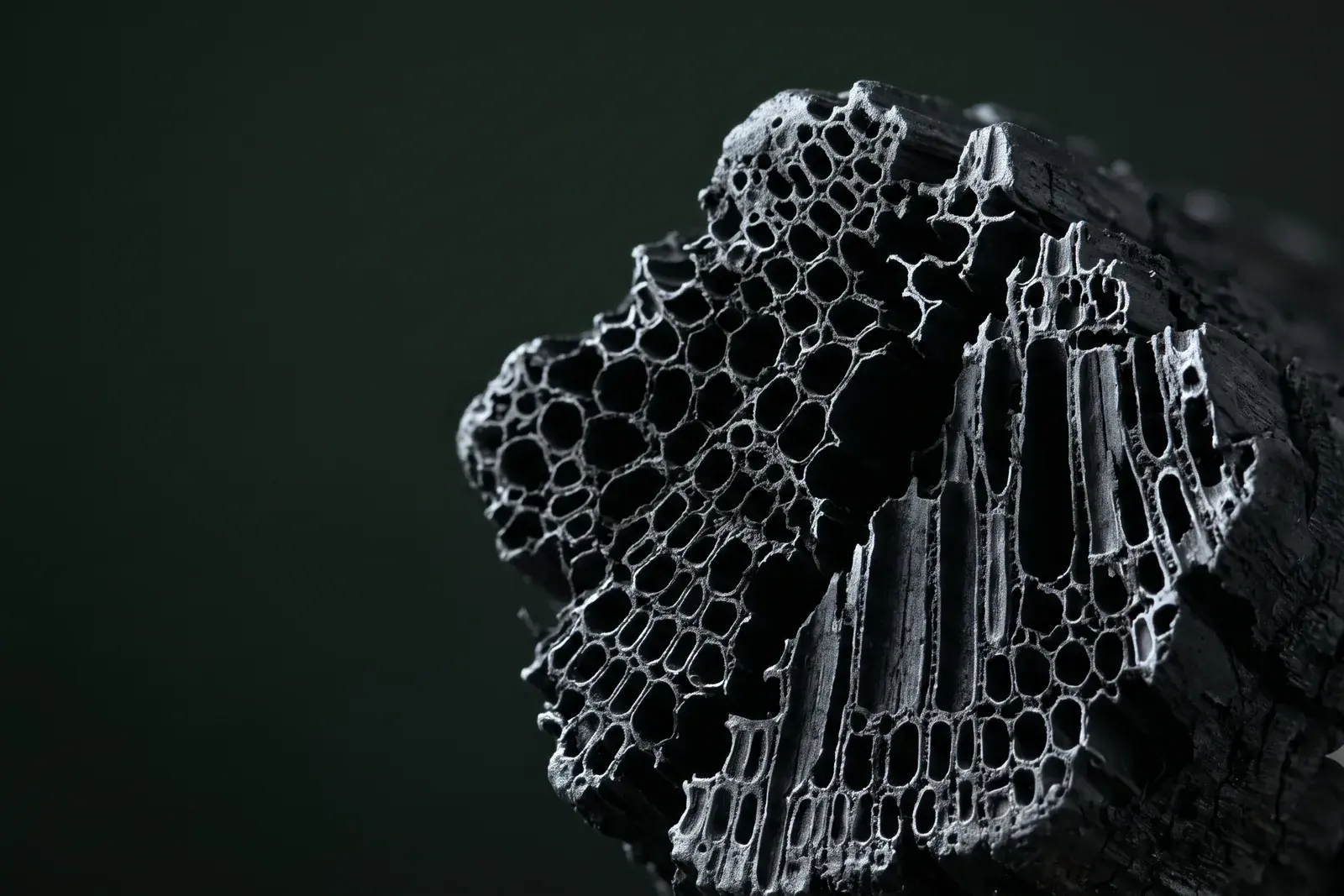
A tree is a temporary carbon store. It holds carbon for as long as it lives, and gives most of it back within decades of dying — microbes are extremely good at eating plant matter, because plant matter is what they evolved to eat. Any credible removal has to break that cycle. Biochar breaks it by changing the food.
Pyrolysis — heating biomass in the near-absence of oxygen — does not simply dry or char the material. It rearranges its molecular architecture into a form the soil food web has no efficient enzyme for. That single fact is the basis of the centuries-scale permanence claim, and everything else in this article is about how we know it and how we prove it batch by batch.
What pyrolysis actually does to a molecule
Fresh biomass is mostly cellulose, hemicellulose and lignin: long chains rich in oxygen and hydrogen, held together by bonds that microbial enzymes cleave for a living. Heat that material to roughly 450–700 °C without oxygen and the chains break apart. Volatile compounds — water, oxygen- and hydrogen-bearing fragments — leave as gas and condensable vapour. What stays behind is progressively stripped of oxygen and hydrogen, and the remaining carbon reorganises into fused aromatic rings: flat, stacked, highly stable sheets of carbon [1][2].
Fig. 1 — From chain to ring — what heat removes and what it leaves
Two things happen at once, and both matter. The material loses the hydrogen and oxygen that made it digestible, and it gains an aromatic structure with no convenient handhold for an enzyme. Microbes do not refuse to eat biochar out of preference. They lack a cheap metabolic route into it — degrading a condensed aromatic sheet costs more energy than the carbon inside it returns.
How chemistry becomes a number: the H/C ratio
Aromaticity is not a mood; it is measurable. The molar hydrogen-to-carbon ratio (H/C) falls as pyrolysis proceeds, because hydrogen is exactly what is being driven off as rings form. It has become the standard proxy for durability: the European Biochar Certificate requires H/Corg below 0.7 for a material to be called biochar at all, and registry methodologies scale the permanence they will credit according to where a batch falls below that line [3][4].
Fig. 2 — H/C ratio as a durability proxy (per published standards)
| Molar H/Corg | What it indicates | Status |
|---|---|---|
| > 0.7 | Incomplete pyrolysis — chains, not rings | Not biochar under EBC [3] |
| 0.4 – 0.7 | Aromatic, with a residual labile fraction | Biochar; lower credited permanence |
| < 0.4 | Strongly condensed aromatic carbon | Centuries-scale durability |
This is why we treat pyrolysis conditions as a quality-control problem, not a throughput problem. Running a reactor cooler and faster yields more mass — and less durable carbon per tonne of it. The H/C ratio is where that trade-off becomes visible, and it is measured on every batch rather than assumed from the recipe.
The two-pool reality: what actually decays
No batch is a single substance. Pyrolysed material contains a small labile pool — partly-converted, oxygen-rich fragments and surface residues — alongside the recalcitrant pool of condensed aromatic carbon. Incubation studies consistently show the same shape: the labile fraction is consumed within the first years, after which decomposition slows by orders of magnitude and the curve flattens [1][2].
Fig. 3 — Characteristic two-pool decay — fast loss, then a long flat tail (schematic of published behaviour)
A carbon claim is made against the flat part of that curve, never the whole batch. This is the honest reading of a durability claim: not that every carbon atom survives indefinitely, but that the fraction we credit is the fraction the evidence says will still be there — and the rest is deducted before anything is sold. It is why we certify to the several-centuries class the methodologies actually support, and let the deeper evidence speak for itself rather than inflating the headline.
Three independent lines of evidence
Permanence claims deserve scepticism, so it is worth being explicit about why this one holds. Three bodies of evidence converge, and they fail in different ways — which is exactly what makes their agreement meaningful.
Incubations. Laboratory and field studies measure mineralisation of biochar carbon over months to years and fit decay models to the result. Mean residence times for well-pyrolysed material run to centuries and beyond, scaling with aromaticity [1][2]. Chemistry. The structure itself predicts the outcome: condensed aromatic carbon is thermodynamically and enzymatically hard to attack, and H/C measures how condensed it is [3]. The archaeological record. Char carbon in Amazonian dark earths and in fire-affected soils worldwide is still present and identifiable centuries to millennia after deposition — the long-duration experiment no laboratory can run, already completed [5].
A modelled residence time alone would be weak. Chemistry alone would be theoretical. Old soils alone would be anecdote. The three together are why registries are willing to certify biochar as durable removal at all — and why our work with highly specialised accredited laboratories is built to measure permanence directly from carbon structure, by random reflectance petrography, rather than infer it from process settings.
Common questions
If biochar is so stable, why does any of it decay at all?
Because no batch is chemically uniform. Pyrolysis leaves a small labile fraction — partly-converted, oxygen-rich fragments — alongside the aromatic core. Microbes consume that fraction within a few years, then stall. What remains is the recalcitrant carbon that carries the removal claim, and the accounting only ever counts that part.
Isn't the permanence figure just a modelled number?
The centuries-scale figure comes from three independent lines of evidence that agree: field and laboratory incubations extrapolated with decay models, the chemistry of the material itself (aromaticity measured by H/C ratio), and the direct observation of char carbon still present in soils millennia after it was made. Any one alone would be weak. Together they are the basis registries use.
Does burying biochar deeper make it last longer?
Placement matters less than chemistry. A well-pyrolysed, low-H/C biochar is durable across a wide range of soils and depths; a poorly-pyrolysed one is not durable anywhere. Conditions modulate the rate at the margins — the molecular structure sets the ceiling.
References
- Lehmann, J. & Joseph, S. — Biochar for Environmental Management: Science, Technology and Implementation (Routledge)
- Lehmann, J. et al. — Persistence of biochar in soil, in Biochar for Environmental Management (2nd ed.)
- European Biochar Certificate (EBC) — Guidelines for a Sustainable Production of Biochar (H/C threshold)
- Carbon Standards International — Global C-Sink / C-Sink Biochar standard (permanence factors)
- Glaser, B. et al. — Terra preta / Amazonian dark earths: black carbon persistence in tropical soils
Figures 1 and 3 are schematic illustrations of published behaviour, not measurements from our operations. Thresholds in Fig. 2 follow the EBC and registry methodologies cited. Terms are defined in the glossary.