

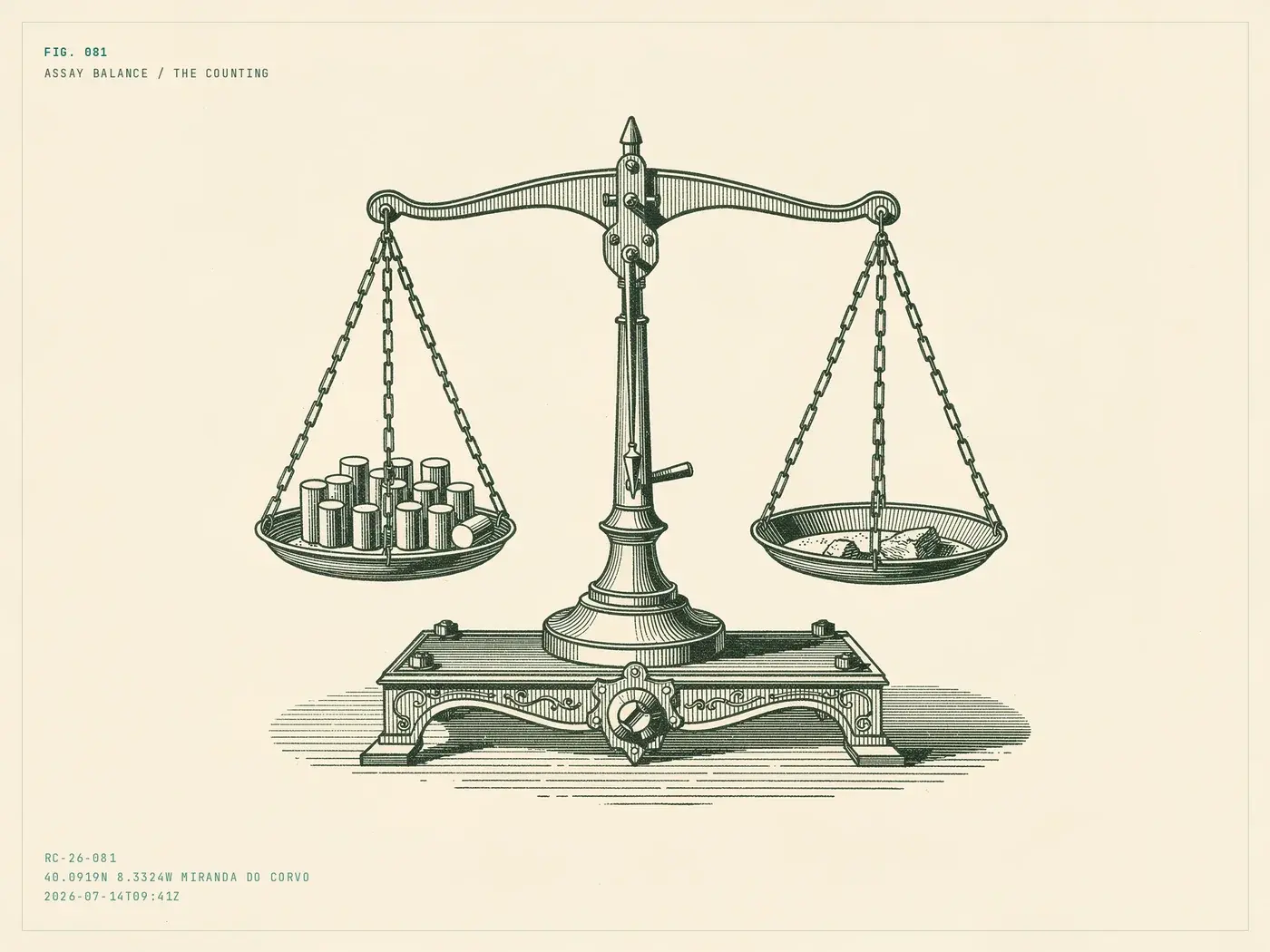
A carbon removal is unusual as purchases go. You cannot inspect it, you cannot use it, and it does not sit in a warehouse. What you are buying is a documented claim that a tonne of CO₂ left the atmosphere and will stay out — and the value of that claim rests entirely on whether it survives being questioned, by your auditor, by a regulator, or by a journalist three years from now.
So the only useful diligence is adversarial. Below are the five questions we think every supplier should have to answer, what a strong answer contains, and the answers that should end the conversation. We publish them because a market where these questions are routine is a market we would rather compete in.
Fig. 1 — The five questions, and what each one is really testing
| Ask | You are actually testing |
|---|---|
| 1. How long does the carbon stay put — and how do you know? | Durability: measured, or asserted |
| 2. Who measured it, and can I see the raw data? | Independence and traceability |
| 3. What did it cost the planet to make? | Full lifecycle accounting, net of emissions |
| 4. Where does the biomass come from? | Sustainability, additionality, counterfactual |
| 5. What happens if you are wrong? | Liability, buffers, reversal handling |
1. How long does the carbon stay put — and how do you know?
Durability is the difference between a removal and a delay. Ask for the mechanism, the number, and the evidence behind the number — in that order.
For biochar, the specific thing to ask for is the H/C ratiomeasured on the material you are buying, not on a reference sample or a brochure average. It is the standard proxy for how aromatic — and therefore how durable — the carbon is, and the European Biochar Certificate requires it below 0.7 for the material to qualify as biochar at all [1]. A supplier who can hand you batch-level H/C data is measuring durability. A supplier who quotes "centuries" and changes the subject is asserting it.
The answer that should worry you:"Biochar is permanent." No material is permanent as a category. Permanence is a property of a batch, and it varies with how that batch was made.
2. Who measured it, and can I see the raw data?
There are three roles in a credible measurement chain, and a supplier who occupies all three is grading their own homework: the producer who makes the material, the laboratory that analyses it, and the auditor who checks the arithmetic against a published methodology. Ask which laboratory, whether it is accredited (ISO/IEC 17025 is the reference), which registry methodology governs the calculation, and who the third-party verifier is [2][3].
Then ask the question that separates the serious from the presentable: can I trace one issued tonne back to its raw records? Batch mass, laboratory certificate, process data, transport, application. If the answer requires someone to assemble a spreadsheet for you, the evidence chain is being reconstructed rather than recorded — and reconstruction is exactly what fails under audit.
Fig. 2 — The evidence chain a buyer should be able to walk backwards
3. What did it cost the planet to make?
A removal is a net figure. Producing biochar consumes energy, moves biomass by road, and runs machinery — and all of it must be deducted before a tonne is claimed. Registry methodologies require this lifecycle accounting, but the assumptions inside it are where optimism hides [2][3].
Ask what is inside the boundary: collection, transport distance, drying, the pyrolysis process itself, and the fate of the pyrolysis gas — whether waste heat is recovered or vented changes the answer materially. Ask whether the supplier uses measured energy data or literature defaults, and which direction they round when uncertain.
The answer that should worry you:a gross tonnage figure with the lifecycle deduction quoted as a small percentage "typical for the industry." Typical is not measured.
4. Where does the biomass come from?
This is the question that has ended more CDR reputations than any measurement error. Biochar is only a removal if the biomass was genuinely surplus — residue that would otherwise decay, burn in the field, or go to a lower-value fate. If a supplier's feedstock competes with food production, drives harvesting that would not otherwise happen, or displaces an existing material use, the climate benefit shrinks or inverts, whatever the laboratory says about the carbon.
Ask for the feedstock type, its origin, the counterfactual (what would have happened to this material otherwise), the collection radius, and the sustainability panel — heavy metals and PAHs, which standards like the EBC require to be tested and bounded [1]. Under the EU's CRCF framework this is not optional diligence; sustainability and additionality are two of the four criteria a certified removal must satisfy [4].
5. What happens if you are wrong?
Every honest supplier will eventually get a number wrong. What matters is what the contract says then. Ask who bears the loss if a batch fails verification, what buffer or reserve exists, whether credits are replaced or refunded, and — for any removal with reversal risk — who is monitoring for reversal and for how long.
Ask, too, whether the supplier has ever restated a number. A supplier who has never found an error in their own data has either been operating for a very short time or is not looking hard enough. Willingness to answer that question honestly tells you more about the quality of the tonnes than any brochure.
How we answer them
We hold ourselves to the same five. Durability is measured per batch, including directly from carbon structure by our highly specialised accredited laboratory partners rather than inferred from process settings. Measurement is split across two independent chains — instruments and accredited laboratory — and when they disagree, the conservative value is carried forward and the difference is logged, which is the subject of a separate article. Lifecycle emissions are deducted from measured data, not assumed. Our feedstock is forestry and agricultural residue — material with a fire-risk problem and no better market — and every batch traces to its origin. And where we cannot yet prove something, we say so rather than round it in our favour.
Common questions
Should I buy removals at all if the market is this immature?
Immaturity is an argument for careful diligence, not for waiting. Durable removal supply is scarce and takes years to build; buyers who engage early shape how suppliers are held to account and secure volume before compliance demand tightens. The mistake is not buying early — it is buying carelessly.
Is a higher price a reliable signal of higher quality?
It is a weak signal, not a reliable one. Price mostly tracks the cost of the removal method, not the rigour of its measurement. A cheap tonne with a full evidence trail beats an expensive tonne with a thin one. Use the five questions, not the price tag.
What does a good answer to 'how do you know?' actually sound like?
Specific and slightly boring. It names the standard and version, the laboratory and its accreditation status, the exact parameters measured, where the raw data lives, who audits it, and where the numbers get conservative. A good answer usually includes what the supplier cannot yet prove — vagueness and total confidence are the same warning sign.
References
- European Biochar Certificate (EBC) — Guidelines for a Sustainable Production of Biochar (H/C threshold, contaminant limits)
- Carbon Standards International — Global C-Sink / C-Sink Biochar standard
- Puro.earth — Biochar Methodology (CORC issuance, lifecycle accounting)
- Regulation (EU) 2024/3012 — Union certification framework for carbon removals (QU.A.L.ITY criteria)
- ISO/IEC 17025 — General requirements for the competence of testing and calibration laboratories
This is a diligence guide, not procurement advice. Requirements differ by registry and by jurisdiction — verify against the primary sources above. Terms are defined in the glossary.