

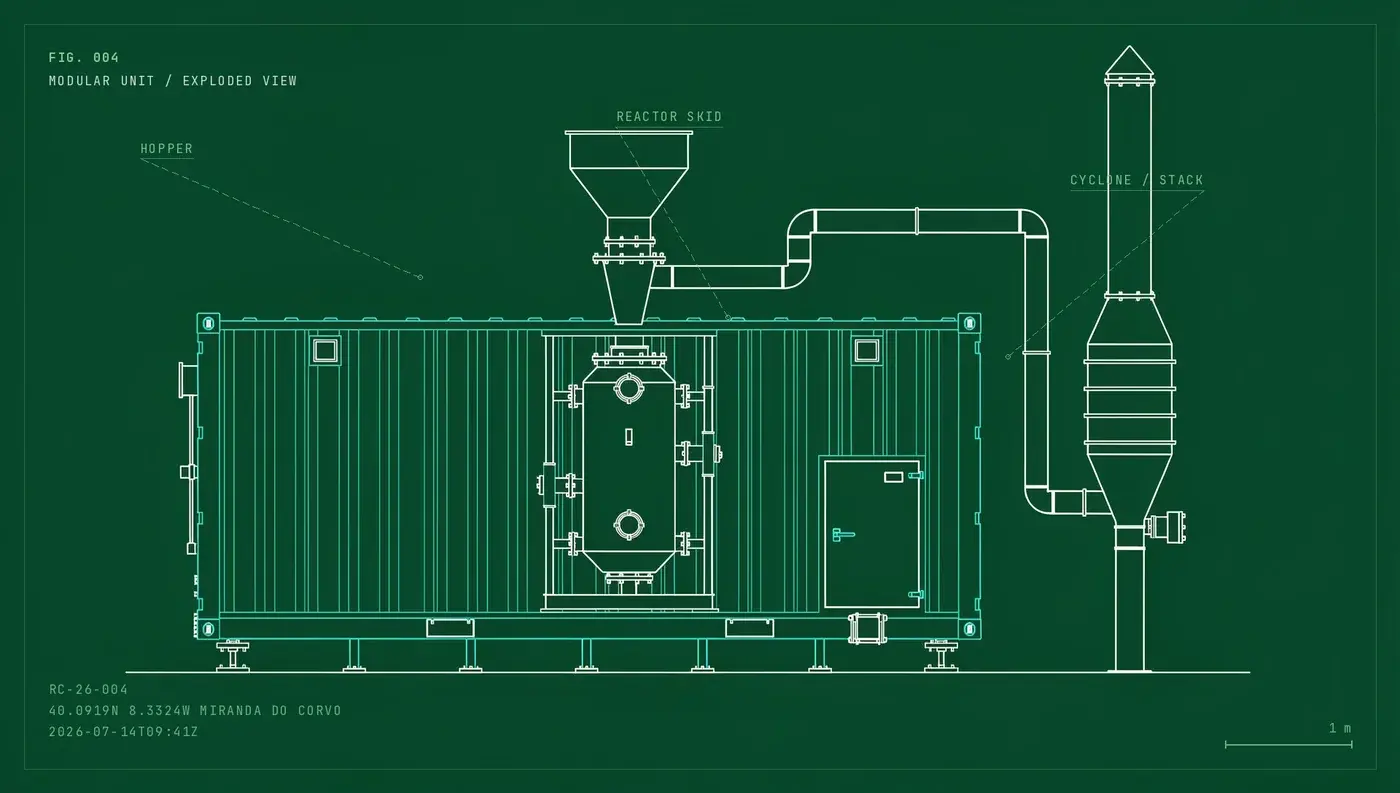
If you run an olive mill, a winery, a nut processor or a rice mill in Iberia, you have probably had the conversation by now. Someone explains that the residue you pay to get rid of is really a carbon asset, that a pyrolysis unit will turn it into biochar, heat and carbon credits, and that the numbers are excellent.
The numbers are sometimes excellent. They are also, in the brochures, almost always calculated in a way that flatters them. This piece is the version we would want to read if we were on the other side of the table — what actually determines whether a unit pays, which residues reward it and which disappoint, and the two arithmetic errors that make bad projects look good.
The first error: wet tonnes are not dry tonnes
Biochar yield is quoted as a fraction of dry matter — typically 25 to 30% for woody material. Your residue is not dry. Fresh olive pomace is around 65% water; grape marc around 55%; tomato pomace can exceed 75%.
So when a mill producing 2,000 tonnes a year of pomace is told to expect "around 30%" as biochar, the implied 600 tonnes is wrong by a factor of three. The real figure is roughly 175 to 210 tonnes, because only about 700 of those 2,000 tonnes were ever dry matter. Everything downstream — the carbon, the revenue, the payback — inherits that error.
Fig. 1 — Two thousand tonnes a year, as received. What each residue actually yields.
| Residue | Water | Biochar | Durable CO₂e | Usable heat |
|---|---|---|---|---|
| Almond & nut shells | ~10% | 450–540 t | 900–1,300 t | Substantial |
| Olive prunings | ~25% | 375–450 t | 750–1,080 t | Substantial |
| Rice husk | ~10% | 540–720 t | 650–1,150 t | Moderate |
| Grape marc (fresh) | ~55% | 225–290 t | 400–660 t | Little to none |
| Olive pomace (fresh) | ~65% | 175–225 t | 315–515 t | None — consumed drying |
Notice that rice husk produces the most biochar by weight and nowhere near the most carbon. Roughly half of a rice husk is silica, which passes straight through pyrolysis into the char and does nothing for the climate. Yield is the wrong headline; yield multiplied by carbon content is the right one.
The second error: the heat is not free
Pyrolysis produces gas, and burning that gas produces heat — around 1.0 to 1.5 MWh per tonne of dry feedstock, net of what the process needs to sustain itself. That is real, and for a dry stream it is genuinely valuable: it displaces the fuel you buy for your dryers, your boilers or your buildings.
But evaporating water costs roughly 0.85 MWh per tonne of water. Run that against fresh olive pomace and the arithmetic is unforgiving: a tonne of it carries about 0.35 t of dry matter, worth some 0.4 MWh, and 0.65 t of water, which costs about 0.55 MWh to drive off. The unit is energy-negative on that stream. It works — but it spends its own heat drying its own feedstock, and there is nothing left over for you.
Break-even sits somewhere around 55 to 60% moisture. Above it, any brochure promising you surplus process heat from a wet residue is either wrong or hoping you will not check. Below it, the heat is one of the best parts of the deal.
The permanence factor is a function of your latitude
Here is the one that surprises people, and it costs Iberian producers real money.
The durability of biochar carbon depends on soil temperature: the warmer the soil, the faster even highly stable carbon eventually degrades. Puro.earth's 2025 biochar methodology encodes this directly — the permanence factor is calculated from the soil temperature where the biochar ends up, alongside the material's hydrogen-to-carbon ratio.
In Finland, with a mean soil temperature around 7 °C, that factor lands near 0.93. In Portugal, at 16 to 17 °C, it lands closer to 0.80. Which means the widely-quoted figures of 3.1 or 3.2 tonnes of CO₂e per tonne of biochar — the ones Nordic producers publish, correctly, about their own operations — do not transfer to Iberia. Our defensible range is roughly 2.0 to 2.4 for woody feedstocks, and lower for silica-rich or ash-heavy ones.
This is not a small adjustment. It is a fifteen-point haircut on the headline carbon number, baked into geography, and any Iberian project modelled on Nordic factors is over-promising by around a third. We would rather tell you now than have your auditor tell you later.
So when does it actually pay?
Strip out the flattery and a clear picture remains. On-site pyrolysis rewards producers whose residue is dry, clean, woody and steady: nut shells, olive stones and prunings, cork, sawmill residue. Those streams give you biochar worth selling, heat worth using, and a carbon removal worth certifying — three revenue lines from something you currently pay to move.
For wet streams— pomace, marc, tomato — the energy case collapses but the disposal case strengthens. Pyrolysis removes 75 to 90% of the mass you have to transport and dispose of, and Portugal's waste tax is legislated to rise from 35 € a tonne in 2025 to 60 € by 2030. The value is in the mass that disappears and the carbon that is certified, not in surplus heat you will never see.
And there is a category where the answer is simply not yet: streams too seasonal to justify a unit that sits idle ten months a year, too small to carry the capital, or too contaminated to certify. We have told prospective clients this, and we would rather keep doing so than install equipment that disappoints and a carbon claim that cannot be defended.
If you want to see what your own stream would do, the estimator on our engineering page runs exactly the arithmetic above — including the parts that do not flatter us.
Common questions
Is olive pomace worth pyrolysing at all?
Yes — but for disposal and carbon, not for energy. Fresh pomace is roughly two-thirds water, so the unit's own recovered heat is consumed drying it, and a wet tonne yields only about a tenth of its mass as biochar. What it does deliver is the removal of most of a genuine disposal liability, plus a durable carbon claim. If someone sells you pomace on the promise of surplus process heat, check their arithmetic.
Why is rice husk biochar worth less carbon than wood biochar?
Because roughly half of it is silica, not carbon. Rice husk gives the highest biochar yield by weight of any common residue — 30 to 40% of dry matter — and one of the lowest carbon contents, around 50%. A certified rice-husk batch can deliver under 1.4 tonnes of CO₂e per tonne of biochar where a woody char delivers over 2. It is still worth doing; just not for the reason the yield figure suggests.
Can I sell the carbon credits from my own unit?
Yes, or you can keep the removal inside your own footprint — insetting — and report it against your own emissions. What you cannot do is both. The constraint is not commercial but methodological: a tonne is issued once, on one registry, and claimed once. Which route is better depends on whether your buyers care more about your footprint or your balance sheet.